- "A" proposition
In the traditional notation for categorical logic, a proposition that is both universal in quantity and affirmative in quality.
Example: "All dogs are mammals."
Such a proposition affirms of each and every dog that it is also a mammal. Its contradictory is an "O" proposition with the same subject and predicate terms.
- abduction
A heuristic procedure that reasons inductively from available empirical evidence to the discovery of the probable hypotheses that would best explain its occurrence. Both Peirce and Reichenbach developed detailed theories about the invention of such hypotheses in what is sometimes called "the logic of discovery." The success of this enterprise may founder on the underdetermination of incompatible hypotheses.
Recommended Reading: Abduction and Induction: Essays on Their Relation and Integration, ed. by Peter A. Flach and Antonis C. Kakas (Kluwer, 2000) {at Amazon.com} and Douglas Walton, Argument Structure: A Pragmatic Theory (Toronto, 1996) {at Amazon.com}.
Also see OCP, Paul Thegard and Cameron Shelley, DPM, and OCDL.
- Abelard, Peter (1079-1142)

French scholastic logician whose sexual relationship with his teen-aged student Héloïse provoked the vengeful anger of her uncle, Fulbert, in 1118. Despite the many distractions of the turbulent life he described in Historia Calamitatum Mearum (The History of my Misfortunes), Abelard embarked on a monastic career of detached contemplation marked by intellectual independence from both traditional authorities and contemporaneous fashions. In commentaries on the logic of Aristotle and his own Dialectica, Abelard invented a novel solution to the problem of universals that rejected both realism and nominalism in their most extreme forms. Only individual things exist for Abelard, but general terms have universal applicability to things whose common features are known by a process of mental abstraction. Abelard also wrote on the difficulties involved in scriptural interpretation in Sic et Non (For and Against) (1122) {at Amazon.com} and on the importance of human intentions for theological ethics in Scito te Ipsum (Know Thyself) {at Amazon.com}.
Recommended Reading: Five Texts on the Mediaeval Problem of Universals, ed. by Paul Vincent Spade (Hackett, 1994) {at Amazon.com}; John Marenbon, The Philosophy of Peter Abelard (Cambridge, 1999) {at Amazon.com}; and Letters of Abelard and Heloise, ed. by Betty Radice (Penguin, 1998) {at Amazon.com}
Also see R. J. Kilcullen, OCP, The Ecole Initiative, ColE, ODQ, ELC, William Turner, MacE, TTSB, and CE.
- Absolute, the
The solitary, uniquely unconditioned, utterly independent, and ultimately all-encompassing being that comprises all of reality according to such Romantic idealists as Schelling, and Hegel. British philosopher F.H. Bradley emphasized that the Absolute must transcend all of the contradictory appearances of ordinary experience, while American Josiah Royce took the Absolute to be a spiritual entity whose self-consciousness is reflected only imperfectly in the totality of human thought.
Also see OCP, BGHT, CE, and ColE.
- Absorption (Abs.)
A rule of inference of the form:
	p É q
	______________

	p É ( p · q )
Example: "If Mary comes to the party, then so will George. Therefore, if Mary comes to the party, then both Mary and George will."
As a simple truth-table shows, any argument of this form is valid.
- abstraction
The process of forming a general concept by omitting distinguishing features from the notions of particular things, or the end result of that process. Introduced by Peter Abelard as part of his solution to the problem of universals, abstraction became crucial for Locke's account of our use of general terms. Thus, for example, the idea of "green" could in principle be derived by abstracting from one's specific experiences of a summer lawn, the leaves of trees, and emeralds. Berkeley, on the other hand, argued that abstract ideas in this sense are impossible because every sensible idea has only particular content.
Recommended Reading: Berkeley on Abstraction and Abstract Ideas, ed. by Willis Doney (Garland, 1993) {at Amazon.com} and Roger Teichmann, Abstract Entities (St. Martin's, 1992) {at Amazon.com}.
Also see OCP, Andrew Brook, BGHT, and Richard Hooker.
- absurd
Contrary to reason or beyond the limits of rationality; paradoxical, nonsensical, or meaningless. According to Camus, Sartre, and other existentialists, absurdity is an inescapable consequence of any sensitive effort to live in the face of an indifferent reality. The human tendency to desire most passionately what we can never have is absurd in this sense.
Recommended Reading: Donald A. Crosby, Specter of the Absurd: Sources and Criticisms of Modern Nihilism (SUNY, 1988) {at Amazon.com}; Richard E. Baker, The Dynamics of the Absurd in the Existentialist Novel (Peter Lang, 1993) {at Amazon.com}; and Martin Esslin, The Theatre of the Absurd (Viking, 1992) {at Amazon.com}
Also see OCP, Donna Summerfield, MacE, BGHT, and Bob Lane.
- Abunaser
Latinized form of the name of Persian philosopher al-Farabi.
- accent, fallacy of
An informal fallacy that arises from the ambiguity produced by a shift of emphasis in spoken or written language.
Example: "Joan said that she never wants to see another Demi Moore movie, so we won't show her another one; we'll just play this same one over and over again."
In such instances, an uninflected reading of the premise often provides no reason at all for believing the conclusion.
- accident
A feature that something happens to have but might have existed without having, since this feature is no part of the very nature of the thing, in contrast to the essence without which the thing could not be at all.
Also see OCP.
- accident, fallacy of {Lat. a dicto simpliciter ad dictum secundum quid}
The informal fallacy of applying a generally reliable rule to a particular case without considering the qualifying features that make it an exception to the rule.
Example: "Since authors of best-selling books usually appear on television talk shows, and the Pope is in fact the author of a best-selling book, it follows that the Pope will soon appear on a television talk show."
Unlimited applicability to every instance would follow syllogistically only from a genuinely universal proposition, the truth of which is often difficult to defend. Merely probable guidelines are easier to establish as "rules of thumb," but do not deserve to be applied so indiscriminately.
- act / rule utilitarianism
Distinction between ways of applying the greatest happiness principle for moral evaluation on utilitarian grounds. Act-utilitarianism supposes that each particular action should be evaluated solely by references to its own consequences, while rule-utilitarianism considers the consequences of widespread performance of similar actions.
The act-utilitarian asks, "How much pleasure or pain would result if I did this now?"
The rule-utilitarian asks, "What pleasure or pain would result if everyone were always to do this?"
Since the answers to these questions may be quite different, they may lead to distinct recommendations about moral conduct. Although Mill noted that reliance on moral rules may be of practical use in decision-making, he argued that their influence should remain defeasible in particular circumstances.Recommended Reading: J.J.C. Smart and Bernard Williams, Utilitarianism: For and Against (Cambridge, 1973) {at Amazon.com}
Also see OCP, R. N. Johnson, and IEP.
- action theory
Branch of philosophy concerned with the analysis and explanation of what human beings do. Understanding the relation between choice or volition and the performance of an action seems crucial for the ascription of responsibility in ethics.
Recommended Reading: Readings in the Theory of Action, ed. by Norman S. Care and Charles Landesman (Indiana, 1968); The Philosophy of Action, ed. by Alfred R. Mele (Oxford, 1997) {at Amazon.com}; and Philosophical Perspectives: Action Theory and Philosophy, ed. by James E. Tomberlin (Ridgeview, 1990) {at Amazon.com}.
- actuality / potentiality {Gr. energeia [energeia] / dunamiV [dynamis]}
Aristotle's distinction between what really is the case and what merely has the power to change or come to be the case. Thus, for example, this fresh acorn is actually a seed but only potentially an oak tree.
Also see CE.
- Addams, Jane (1860-1935)
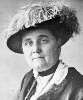
American pragmatist and social worker. Concerned by the dismal living conditions endured by women, minorities, and the working poor, Addams established Hull House in Chicago as a social settlement in 1889 and campaigned tirelessly for women's suffrage, world peace, and economic justice. Her address to the Chicago Liberty Meeting, Democracy or Militarism (1899) and the pamphlet Why Women Should Vote (1909)
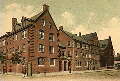 are representative expressions of her belief that women properly exert a pacifistic influence on American political life.
Addams's writings on social issues include Democracy and Social Ethics (1902), Newer Ideals of Peace (1907),
A New Conscience and an Ancient Evil (1911),
Twenty Years at Hull House (1912) {at Amazon.com}, The Larger Aspects of the Women's Movement (1914), and Women, War, and Suffrage (1915).
Addams shared the 1931
Nobel Prize for peace.
are representative expressions of her belief that women properly exert a pacifistic influence on American political life.
Addams's writings on social issues include Democracy and Social Ethics (1902), Newer Ideals of Peace (1907),
A New Conscience and an Ancient Evil (1911),
Twenty Years at Hull House (1912) {at Amazon.com}, The Larger Aspects of the Women's Movement (1914), and Women, War, and Suffrage (1915).
Addams shared the 1931
Nobel Prize for peace.
Recommended Reading: Allen F. Davis, American Heroine (Ivan R. Dee, 2000) {at Amazon.com} and Mary Jo Deegan, Jane Addams and the Men of the Chicago School, 1892-1918 (Transaction, 1990) {at Amazon.com}
Also see The Hull House Association, MDBW, ColE, PBDW, and Philosopher's Corner.
- Addition (Add.)
A rule of inference of the form:
	p
	_____

	p Ú q
Example: "It is raining. Therefore, either it is raining or the sun is shining."
Although its use in ordinary thought is notably rare, this pattern of reasoning serves a vital role in the construction of formal proofs in many systems of logic.
- ad hominem argument (argument against the person)
The informal fallacy of supposing that a proposition should be denied because of some disqualifying feature of the person who affirms it. This fallacy is the mirror image of the appeal to authority. In its abusive form, ad hominem is a direct (and often inflammatory) attack on the appearance, character, or personality of the individual.
Example: "Jeremy claims that Susan was at the party, but since Jeremy is the kind of person who has to ride to work on the city bus, it must be false that she was there."
A circumstantial ad hominem accuses the person of having an alternative motive for defending the proposition or points out its inconsistency with the person's other views. Tu quoque (the "so do you" fallacy) uses a similar method in response to criticism of a position already held.
Recommended Reading: Douglas Walton, Ad Hominem Arguments (Alabama, 1998) {at Amazon.com}.
- adiafora [adiaphora]
Greek term used by the classical Stoics to designate actions that are morally indifferent. On this view, we have no direct obligation either to perform or to avoid such actions, even when they might indirectly affect our general well-being. Thus, for example, although there is no duty to preserve one's own health, doing so is advisable, since it will probably feel good and improve one's capacity for doing what is right. Pyrrho, Carneades, and other Skeptics, on the other hand, argued that there can be no coherent reason for preferring beneficial acts unless they are themselves virtuous.
Recommended Reading: F. E. Peters, Greek Philosophical Terms: A Historical Lexicon (NYU, 1967) {at Amazon.com}.
- Adler, Alfred (1870-1937)
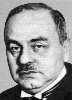
Austrian psychiatrist; author of such books as Studie über Minderwertigkeit von Organen (Study of Organ Inferiority and its Psychical Compensation) (1907), Praxis und Theorie der Individualpsychologie (Practice and Theory of Individual Psychology) (1918) {at Amazon.com}, and Der Sinn des Lebens (What Life Should Mean to You) (1934) {at Amazon.com}. Influenced by the philosophy of Hans Vaihinger, Adler's "individual psychology" focussed on the efforts people invariably make in order to compensate for their (self-perceived) inferiority to others, whether it originally arose from a specific physical defect, relative position in the family constellation, particular experiences of humiliation, or a general lack of social feeling for others.
Recommended Reading: Individual Psychology of Alfred Adler: A Systematic Presentation in Selections from His Writings (Harpercollins, 1989) {at Amazon.com}; Superiority and Social Interest: A Collection of Later Writings, ed. by Heinz L. Ansbacher and Rowena R. Ansbacher (Norton, 1979) {at Amazon.com}; and Harold H. Mosak and Michael Maniacci, A Primer of Adlerian Psychology: The Analytic-Behavioral-Cognitive Psychology of Alfred Adler (Brunner/Mazel, 1999) {at Amazon.com}.
Also see C. George Boeree, BGHT on Individual Psychology and The Inferiority Complex, ColE, ODQ, ELC, Österreich-Lexikon, MacE, ODSt, WW20th, and Henry T. Stein.
- Adorno, Theodor Wiesengrund (1903-1969)
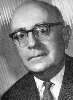
German musicologist, social critic, and political philosopher; author of Philosophie der neuen Musik (The Philosophy of Modern Music) (1949) and Noten zur Literatur (Notes to Literature) (1958-74). A leading member of the Frankfurt school, Adorno traced the development and failure of Western reliance on reason in Dialektik der Aufklärung (Dialectic of Enlightenment) (1947) {at Amazon.com}. In The Authoritarian Personality (1951) Adorno described the ways conformity to the demands of social propriety imposes paradox and contradiction on the lives of individual human beings. Negative Dialektik (Negative Dialectics) (1966) openly defends the critical task of exposing, dissolving, and undermining the harmful influence of rigid conceptual schemes.
Recommended Reading: The Adorno Reader, ed. by Brian O'Connor (Blackwell, 2000) {at Amazon.com}; Simon Jarvis, Adorno: A Critical Introduction (Routledge, 1998) {at Amazon.com}; Martin Jay, Adorno (Harvard, 1984) {at Amazon.com}; Hauke Brunkhorst, Adorno and Critical Theory (U of Wales, 1999) {at Amazon.com}; and The Actuality of Adorno: Critical Essays on Adorno and the Postmodern, ed. by Max Pensky (SUNY, 1997) {at Amazon.com}.
Also see OCP, Carsten Allefeld, ColE, ELC, Andy Blunden, and Dan Bucsescu, WW20th, and MacE.
©1997-2001 Garth Kemerling.
Questions, comments, and suggestions may be sent to: gkemerling@philosophypages.com
