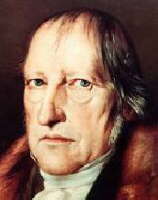
Georg Wilhelm Friedrich Hegel
(1770-1831)Life and Works
. . Dialectic
. . Subjective
. . Objective
. . Absolute
Bibliography
Internet SourcesBorn in Stuttgart and educated in Tübingen, Georg Wilhelm Friedrich Hegel devoted his life wholly to academic pursuits, teaching at Jena, Nuremberg, Heidelberg, and Berlin. His Wissenschaft der Logik (Science of Logic) (1812-1816) attributes the unfolding of concepts of reality in terms of the pattern of dialectical reasoning (thesis — antithesis — synthesis) that Hegel believed to be the only method of progress in human thought, and Die Encyclopädie der philosophischen Wissenschaften im Grundrisse (Encyclopedia of the Philosophical Sciences) (1817) describes the application of this dialectic to all areas of human knowledge.
 Hegel's Naturrecht und Staatswissenschaft im Grundrisse and Gundlinien der Philosophie des Rechts (Philosophy of Right) (1820) provide an intellectual foundation for modern nationalism.
Hegel's absolute idealism is evident even in the early Phänomenologie des Geistes
 (Phenomenology of Mind) (1807).
There Hegel criticized the traditional
epistemological distinction of objective from subjective and offered his own
dialectical account of the development of consciousness from
individual sensation through
social concern with ethics and politics to the pure consciousness of the World-Spirit in
art, religion, and philosophy. The result is a comprehensive world-view that encompasses the historical development of civilization in all of its forms.
(Phenomenology of Mind) (1807).
There Hegel criticized the traditional
epistemological distinction of objective from subjective and offered his own
dialectical account of the development of consciousness from
individual sensation through
social concern with ethics and politics to the pure consciousness of the World-Spirit in
art, religion, and philosophy. The result is a comprehensive world-view that encompasses the historical development of civilization in all of its forms.
|
Recommended Reading:
Primary sources:
Secondary sources:
|  |
Additional on-line information about Hegel includes:
- Paul Redding's thorough article in * The Stanford Encyclopedia of Philosophy.
- Peter Singer's article in The Oxford Companion to Philosophy.
- Related OCP articles on:
the Absolute,
concrete universals,
German philosophy,
Hegelianism,
philosophy of history,
idealism,
master and slave,
metaphysics,
nationalism,
the owl of Minerva,
political philosophy,
progress,
philosophy of religion,
philosophical romanticism,
the State,
Vorstellung, and
world-soul.

- The thorough collection of resources at EpistemeLinks.com.
- The article in the Columbia Encyclopedia at Bartleby.com.
- A glossary of Hegelian terminology from Carl Mickelesen.
- Andy Blunden's extensive Hegel by Hypertext site.
- A section on Hegel from Alfred Weber's history of philosophy.
- Snippets from Hegel in The Oxford Dictionary of Quotations.
- Andrew Buchwalter on Hegel's philosophy of law.
- An outline of the Encyclopedia by W. T. Stace.
- A summary discussion from G. J. Mattey.
- An analysis of Hegel's system by Herbert Marcuse.
- A philosophical biography from Uwe Wiedemann.
- Antoinette M. Stafford's feminist critique of Hegel.
- William Turner's article in The Catholic Encyclopedia.
- The Bloomsbury Guide to Human Thought on Nationalism.
- A summary treatment from Robert Sarkissian.
- Björn Christensson's brief guide to Hegel on-line.
- The Macmillan Encyclopedia 2001 on Hegel and Hegelianism.