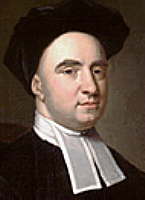
George Berkeley
(1685-1753)Life and Works
. . Abstract Ideas
. . Immaterialism
. . Spirits
. . Common Sense
. . Science
Bibliography
Internet SourcesIrish clergyman George Berkeley completed his most significant philosophical work before turning thirty, during his years as a student, fellow, and teacher at Trinity College, Dublin. Using material from his collegiate notebooks on philosophy, he developed a series of texts devoted to various aspects of a single central thesis: that matter does not exist. In An Essay Towards a New Theory of Vision (1709), for example, he argued that the phenomena of visual sensation can all be explained without presupposing the reality of external material substances; the objects we see are merely ideas in our minds and that of god. Berkeley spent most of his mature years in London, travelling briefly to Rhode Island in the vain hope of securing financial support for a college to be established in Bermuda. He was appointed Anglican bishop of Cloyne in 1734.
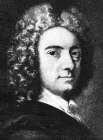 His later writings, which rarely receive philosophical attention, include: criticisms of Newton's calculus and theory of space in De Motu (1721) and
The Analyst (1734);
a defence of traditional Christian doctrine in the Alciphron (1734); and, in the interminable Siris (1744), a lengthy disquisition on the presumed benefits to health of "tar-water."
His later writings, which rarely receive philosophical attention, include: criticisms of Newton's calculus and theory of space in De Motu (1721) and
The Analyst (1734);
a defence of traditional Christian doctrine in the Alciphron (1734); and, in the interminable Siris (1744), a lengthy disquisition on the presumed benefits to health of "tar-water."
It is the earlier immaterialist philosophy, in which he employed strictly empiricist principles in defence of the view that only minds or spirits exist, for which Berkeley is now remembered. He opened A Treatise concerning the Principles of Knowledge (1710) rather technically, with an extended attack on Locke's theory of abstract ideas. The book continues with arguments designed to show that sensible qualities—both secondary and primary—can exist only when perceived, as ideas in our minds. Since physical objects are, on Berkeley's view, nothing more than collections of such qualities, these sensible objects, too, are merely ideas. In what he believed to be his most devastating point, Berkeley argued that it is literally inconceivable that anything like a material substance could exist independently of the spirits or active thinking substances that perceive it.
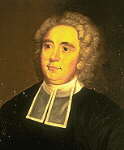 Through the remainder of the Principles, Berkeley tried to distinguish his position from that of
Malebranche, defended its application to the achievements of modern
science, and extolled its beneficial consequences for traditional
religion.
Through the remainder of the Principles, Berkeley tried to distinguish his position from that of
Malebranche, defended its application to the achievements of modern
science, and extolled its beneficial consequences for traditional
religion.
The same central doctrine, supported by a very similar train of thought, is expressed in different form in Three Dialogoues between Hylas and Philonous (1713). Here Berkeley spoke through Philonous ("Mind-lover"), who tries to convince his reluctant friend Hylas ("Woody") that it is only by rejecting the artificial philosophical concept of material substance that skepticism can be finally defeated and the truths of common-sense secured.
|
Recommended Reading:
Primary sources:
Secondary sources:
|  |
Additional on-line information about Berkeley includes:
- Peter Lloyd's excellent collection of * Berkeley Studies.
- Geoffrey J. Warnock's article in The Oxford Companion to Philosophy.
- Related OCP articles on:
abstraction,
the egocentric predicament,
English philosophy,
esse est percipi,
idealism,
Irish philosophy,
jaundice,
primary and secondary qualities,
spirit, and
tar-water.

- The thorough collection of resources at EpistemeLinks.com.
- Allan F. Randall on Berkeley's rejection of abstract ideas.
- a thorough article in The Internet Encyclopedia of Philosophy.
- G. J. Mattey's lecture notes on Berkeley.
- The article in the Columbia Encyclopedia at Bartleby.com.
- A section on Berkeley from Alfred Weber's history of philosophy.
- Snippets from Berkeley in The Oxford Dictionary of Quotations.
- D.R. Wilkins' survey of on-line materials.
- Björn Christensson's brief guide to Berkeley studies.
- A discussion of Berkeley's views on mathematics at Mathematical MacTutor
- a brief entry in The Macmillan Encyclopedia 2001.