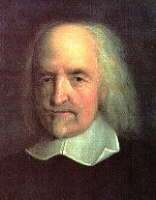
Thomas Hobbes
(1588-1679)Life and Works
. . Human Nature
. . Society
Bibliography
Internet SourcesDecades after completing his traditional education as a classicist at Oxford and serving as tutor of William Cavendish, Thomas Hobbes became convinced that the methods employed by mathematicians and scientists—geometry, in particular—hold the greatest promise for advances in human knowledge. Voluntarily exiled to Holland during the years of Parliamentary Rule, the royalist Hobbes devoted much of his time to the development and expression of a comprehensive philosophical vision of the mechanistic operation of nature. Although he returned to England with the restoration of Charles II, Hobbes was for the remainder of his life embroiled in bitter political and religious controversies. They did not prevent the ninety-year-old Hobbes from completing his English translation of the works of Homer.
Hobbes's first systematic statement of a political philosophy, Elements of Law, Natural and Politic (1640), relies heavily upon the conception of natural law that had dominated the tradition from Aquinas to Grotius.
 But his views had begun to change by the time he reissued portions of his work in a Latin version known as
De Cive (1642).
But his views had begun to change by the time he reissued portions of his work in a Latin version known as
De Cive (1642).
The Leviathan (1651) is the most complete expression of Hobbes's philosophy. It begins with a clearly materialistic account of human nature and knowledge, a rigidly deterministic account of human volition, and a pessimistic vision of the consequently natural state of human beings in perpetual struggle against each other. It is to escape this grim fate, Hobbes argued, that we form the commonwealth, surrendering our individual powers to the authority of an absolute sovereign. For Hobbes, then, individual obedience to even an arbitrary government is necessary in order to forestall the greater evil of an endless state of war.
|
Recommended Reading:
Primary sources:
Secondary sources:
|  |
Additional on-line information about Hobbes includes:
- Bernard Gert's article in The Oxford Companion to Philosophy.
- Related OCP articles on:
conservatism,
the social contract,
English philosophy,
the Leviathan,
materialism,
"nasty, brutish, and short",
the people,
the persecution of philosophers,
political philosophy, and
the state of nature.

- An article in The Internet Encyclopedia of Philosophy.
- The article in the Columbia Encyclopedia at Bartleby.com.
- The thorough collection of resources at EpistemeLinks.com.
- Hobbesiana from Nicola Caleffi.
- G. J. Mattey's summary discussion of Hobbes.
- A section on Hobbes from Alfred Weber's history of philosophy.
- Steven Darwall's lectures on Hobbes.
- A summary treatment by Robert Sarkissian.
- Snippets from Hobbes in The Oxford Dictionary of Quotations.
- Rosalba Dur´n Forero's comparison of Hobbes with Spinoza on gender equality.
- The Bloomsbury Guide to Human Thought on The State and Sovereignty.
- A paper by Juhani Pietarinen on Hobbes and the Prisoner's Dilemma.
- Björn Christensson's brief guide to on-line resources.
- Discussion of Hobbes's mathematical significance at Mathematical MacTutor.
- a brief entry in The Macmillan Encyclopedia 2001.